Saturday, August 18, 2007

Jeremy Blake 1972-2007- part 2

Behold the Bubbles:
The man who made paintings move


Overshadowed by the death of visionary filmmakers Ingmar Bergman and Michelangelo Antonioni, Jeremy Blake’s tragic suicide earlier this month seems to have slipped under the radar of much of the filmmaking and film-going community. With the death of these two legendary directors, who worked against history and the conventions laid out before them, it begs that we examine Blake’s work and why it has not gotten furthur recognition. It should prompt, more than ever, our awareness of how important filmmakers of Blake’s candor are, without their experiments and awareness, there will be no future Bergman’s or Godard’s. Bergman and Antonioni, before they became influential, and had the ability to create anything they pleased (see Bergman’s insane soap commercials), saw things in a different way, and it wasn’t easy for the world of cinema to accept them. They were outsiders who believed in the cinema they could create. Blake was similar, perhaps a bit before his time, perhaps saw a little more outside of the box than they did, but he was certainly just as much, if not more, of an outsider. (Though he would be more easily likened to a present day Maya Deren. Ditto on seeing outside of the box.)


Blake’s, limited, catalogue of short films stands as a testament to his goal of bridging the gap between painting and cinema. His films were tasteful, lush, intriguing and beautiful. His most accessible work couldn’t bring him into the forefront of viewer’s minds, by the very type of work he was doing was never going to be a name like Bergman, but he was seen, whether viewers knew it or not. Particularly his work on Paul Thomas Anderson’s Punch Drunk Love and his music video for Beck’s “Round the Bend” created a platform from which viewers were exposed to his work, exposed to something new, irrational and completely logical. His work with Beck is so serene and conceptually synchronized that it should have gained him notoriety with music video directors like Spike Jonze and Michel Gondry. The flow of pieces like “Round the Bend,” or “1906,” is striking, it’s contrary motion of static, yet constantly resonating and dissolving images, speaks to a course of human nature that few filmmakers have ever had the capability of capturing. His work with digital photography, multiple interfaces and painting stand to be highly influential to future filmmakers who can see cinema outside of corporate movie houses, for those who see cinema on the walls of galleries, on the sides of crumbling brownstones, on crudely hung curtains in living rooms and night skies, Jeremy Blake will be a visionary they look back upon. Someone who will inspire the world’s future Deren’s, Brakhage’s, Anger’s and Blake’s.


Jeremy Blake's 'Sodium Fox'


Beck's music video "Round the Bend," directed by Jeremy Blake


A very short clip from Blake's video 1906:


Trailer for Paul Thomas Anderson's 'Punch Drunk Love' featuring pieces of Blake's color patterns for the film:

Friday, August 3, 2007

Cormac McCarthy to pen 'Toy Story 3'?

Has the success of the Oprah endorsed 'The Road' and the upcoming big screen debut of 'No Country for Old Men' gone to his head? I couldn't resist posting this. It's great. Click here for the article from Village Voice.

Wednesday, August 1, 2007

Hey! Tired of not being able to access endless troves of junk by Roger Ebert? Worry no more.

An endless myriad of reviews is now available online (as if there wasn't already) because an archive of the complete reviews of Siskel, Ebert and Roeper has been introduced. You can check out The Balcony here. It's actually pretty impressive. At the moment it's really pretty barebones (except for the thousands of reviews on the site) but I'm sure it's going to get the royal treatment in time.

The first feature available on the site is Ebert and Scorsese discussing films of the 90's, access it here

Jeremy Blake 1972-2007

Artist Jeremy Blake has passed away today, New York Police have said, in an apparent suicide at his New York City apartment. An up-and-coming avant-garde artist who sought to bridge the worlds of film and painting, his contirbutions to the world of art, by age 35, have been significant. One of his best known pieces of work were the hallucinatory sequences of blending primary colors between scenes in Paul Thomas Anderson's 2002 film 'Punch Drunk Love.' His long-time companion, Theresa Duncan, a filmmaker, artist and sometime video-game designed, commited suicide early last month in the couples Manhattan home. Blake was a visionary artist whose work will be missed.


for more on Jeremy Blake check out the article at Green Cine

Venice Film Fest announces Queer Lion Award

the Venice Film Festival has announced today that, after four years of negotiations, they will premiere the Queer Lion Award, paralleling their prestigous Golden Lion, for the best film with queer characters and/or themes. The award will be the first of it's kind at the major festivals of the world.

for more information check out the article at indieWIRE

Tuesday, July 31, 2007

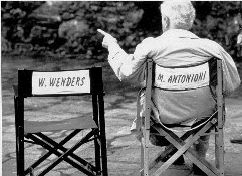
Michelangelo Antonioni 1912-2007

At age 94 legendary filmmaker Michelangelo Antonioni has passed away last night at his home in Rome. Famous for his cinema of alienation and his fantastical visions, he, along with Federico Fellini, turned Italy away from the Neorealistic visions of Vittorio de Sica and Roberto Rossellini towards a cinema of the imagination.

Though he was far from being a typical Italian filmmaker, some of his most famous films created in England. With films such as 'Blow-up' and 'L'Avventura' he can only be considered one the world's greatest cinematic assets. His trilogy on alienation and the open spaces spaces surrounding the human psyche, including the aformentioned ' L'Avventura,' 'L'Eclisse,' and 'La Notte,' still stands, ironically along with Bergman's 60s trilogy, as one of the most tortured series of films on humanity, while remaining entirely humanistic.

Jack Nicholson once said of Antonioni, while presenting him with the lifetime achievement Oscar, "In the empty, silent spaces of the world, he has found metaphors that illuminate the silent places our hearts, and found in them, too, a strange and terrible beauty: austere, elegant, enigmatic, haunting." Nicholson starred in Antonioni's 'The Passenger' which is emblematic of his paced, contemplative style. The film ten minute finale is filmed in complete silence, which had (and has) some viewers ripping their hair out while still recieving standing ovations from others (this happened just last year when I went to see a restored print at the the cinema).

Antonioni made films through the end of his life, collaborating with Wong Kar-Wai and Steven Soderbergh on the pasted together 'Eros,' in 2004. Walter Veltroni, the mayor of Rome, put it lightly hen he said, "With Antonioni, not only has one of the greatest living directors been lost, but also a master of the modern screen."

A screenshot from 'L'Eclisse'


A clip from 'Blow-up' with the Yardbirds performaing in a studio. Emblematic of the tension filled shots that were charicteristic of Antonioni: at once static, quiet, paced while remaining intense, busy, cluttered. For a rock-n-roll scene the shot is so still and quiet, the soundtrack is loud, but he never focuses on the sound, it seems to be more about the group of collected people, the power of the moment, the intensity of community, the power of power. Anyhow, 'Blow-Up:'

Monday, July 30, 2007

Ingmar Bergman 1918-2007


Famed Swedish director Ingmar Bergman died Monday morning at his home in Sweden. Bergman was one of the world's greatest filmmakers, along with legends like Godard, Fellini and Kurosawa, he can be said to have revealed the potentials of cinema as an art form as much as an individual in film's short history. He was best known for his personal, tormented films on the human psyche, movies as divergent as meditations on mental illness, familial abuse and plague. He broke barriers, broke the fourth wall, and created what we consider cinema as much as Griffith did. Making films up until his continuation of 'Scenes from a Marriage,' 'Saraband,' in 2003, and writing a TV play in 2005. His death is great loss to art in the world at large. Woody Allen noted, in 1988, that Ingmar Bergman was "the greatest film artist, all things considered, since the invention of the motion picture camera."
This week, in the reviews section, look for the other two parts of his trilogy (along with Through a Glass Darkly, that was published last week) as tribute to his passing, as well as his close friend and frequent cinematographer, whom also passed this month, Sven Nykvist.

Woody Allen discusses Bergman's genius. From the New York Times

Click here for a photo essay of Bergman's career from The Gaurdian.