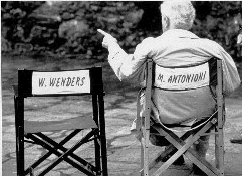
1. Michelangelo Antonioni was not included. Of course he seems a little more in the media at the moment because of his recent death, but this is one of the great directors. You can't go including Sofia Coppola, Curtis Hansen and James Whale and then deny Antonioni. Poor decision.

-still from Antonioni's 'Blowup'-
2. D.W. Griffith at 91 and Sergei Eisenstein at 72. With the error of Antonioni I'm grateful that these people have ever seen films by Griffith and Eisenstein, but to give them so little credit for being the incredible innovators that they were is unthinkable. There is no modern cinema without these two men. Period. Somes examples of how these two don't seem to make much sense, Griffith, at #91, is beat out by Buster Keaton, at #88. Keaton is one of my favorite silent film directors, and I think, though he may not have been as funny as chaplin, he was certainly a better director than Chaplin ever was. But as Griffith and Keaton were both primarily directors of silent films (both short and feature length) saying the man who invented modern editing practices is less important than a man who continued the tradition (albeit very well) of slapstick comedy makes no sense. Sergei Eisenstein, at # 72, (the man who invented montage editing, and wrote countless essays on the uses of montage, that are still taught today) falls one place behind John Sayles, who is a great director, but is far less prolific or influential as Eisenstein...

-still from Eisenstien's 'Battleship Potemkin'-
3. Total exclusion of Italian Neo-realism. Again denying the importance of some figures in film history. No Vittorio De Sica or Roberto Rossellini. This time there is no independent film without these men. John Cassavetes would not have though that he could make a film for next to nothing without the Neo-realists. (Which we can through the early work Antonioni in here as a further denial of the neo-realists.)
This is just the tip of the iceberg, many important film movements are under-represented, I've just chosen the neo-realists for the complete exclusion. The French New-Wave is barely present, Dogme 95 is only represented by Lars Von Trier (whose placement at #86 seems a little odd, but this is subjective criticism and I'm going to avoid that as much as possible so this doesn't turn into an angry rant.) Also all movements of Asian cinema are heavily neglected, sure they've slipped in a couple of safe bets, one Indian director, three from Japan, one anime director (who is curiously high ranked)...but over-all, the movements are neglected.

-still from Rossellini's 'Open City'-
4. To further bash the Italian directors they have placed Federico Fellini at 67 (in my mind he is top ten material, but this should be subjective). The main issue here is the man made hoards of movies, countless numbers of them are still shown in cinema classes across the world and remain extremely important pieces of film art. (La Dolce Vita, 8 1/2, Nights of Cabiria, Amarcord, Roma, etc) The real jab at Fellini here is that people like Bryan Singer, Richard Linklater and John Carpenter are some of the names just ahead of him (65, 64, 63 respectively). Not that any of these directors are necessarily bad, but they certainly aren’t as important as Fellini, and Fellini never even thought about making the artistic compromises they have. (Which is a whole other debate, but is nonetheless relevant when deciding the BEST DIRECTORS EVER.)

-still from Fellini's 'La Dolce Vita'-
5. (John Cassavetes = #60, Jean-Luc Godard = # 59) = Abomination
(Hal Ashby = # 58, Brian De Palma = #54, James Cameron = #38) = Abomination
Again the Ashby, De Palma, Cameron is not all bad (though I'm not much of a fan of De Palma) they have all made some decent movies, successful at the box office, films people remember. But seriously, we are not talking sales here, or who had star power in their films, the label is "best directors." There are truly few directors who could even begin to be considered more visionary than Cassavetes or Godard. These two are rare specimen, directors who can truly be said to have changed cinema. Ashby, De Palma and Cameron are all on the Spielberg side of the best directors, which is fine, Spielberg should be ranked as high as he is, his films aren't really art, but he changed the way people see films. So did Godard and Cassavetes, De Palma hasn't changed anything. This is not a matter of taste; this is a matter of making an arbitrary list that has no sort of standard for judgment. (Godard leads me to the exclusion of Alain Resnais as well, but I'm limiting myself to 5 reasons.)

-still from Godard's 'Bande a part' (Band of Outsiders)-
This is just the beginning of my personal complaints about the list, but many of my complaints are subjective. These five reasons, I believe, are more objective complaints. A pure denial of the talent that has changed the way people go to theaters and the fashion in which people watch cinema.
I think there needs to be a new list made, with some reasonable criteria. Maybe a few more women involved too. Sofia Coppola over Jane Campion, Deepa Mehta and Maya Deren?
Other directors who maybe should have made it: Takeshi Kitano, Seijen Suzuki, Alain Resnais, Wes Anderson (though a long shot, but better and more prolific than Coppola), George Cuckor, Douglas Sirk, F.W. Murnau, Stan Brakhage, Maya Deren(though they've completely denied the existence of alternative forms of cinema besides the blockbuster, independent or classic), Jane Campion, Neil Jordan, Deepa Mehta, Vittorio De Sica, Matthew Barney, Hal Hartley(?), Roberto Rosselini, Guy Maddin, Jacques Rivette, Abbas Kiarostami and the list could continue...(anyone have any ideas?)